The short version: the liquids rule limits the size of the container, not how much liquid is in it. A half-empty 200ml bottle is not allowed; a full 100ml bottle is. Everything has to fit in one clear, resealable, roughly quart-sized bag, one bag per passenger.
This is the rule travellers get wrong most often, and the one that causes the most bin-repacking at security.
The rule as it is actually enforced
- Containers of 100ml / 3.4oz or less. The printed capacity on the bottle is what matters.
- All in one clear resealable bag, roughly one quart or one litre.
- One bag per passenger, out of the carry-on and into a tray unless the checkpoint has scanners that do not require it.
- "Liquid" is broader than you think. Gels, pastes, creams, aerosols and anything spreadable count. Toothpaste, mascara, deodorant sticks that are gel rather than solid, peanut butter, and soft cheese have all caught travellers out.
Some airports have deployed newer CT scanners that relax these limits, and some have then re-tightened them. Rules vary by airport within the same country. Pack to the strict version and you will never be the one holding up the line.
What is exempt
Generally permitted in larger quantities, declared separately at the checkpoint:
- Prescription and essential over-the-counter medication — keep it in original labelled packaging
- Baby formula, breast milk and baby food, when travelling with an infant
- Liquids required for a medical condition
Declare these rather than hiding them in the quart bag. Screeners deal with them constantly and it is faster.
How to decant properly
- Buy bottles, not travel-size products. Travel-size retail products cost several times as much per millilitre and you still end up with the wrong sizes. A refillable bottle set like the 16-Piece Leakproof Travel Bottle Set — sixteen pieces, enough for a household — pays for itself in about two trips.
- Fill to about 80%. Cabin pressure changes push liquid out of a completely full bottle. This is why bottles leak on aircraft and not in your bathroom.
- Squeeze the air out before sealing. Less air means less expansion.
- Label them. Two identical white bottles of shampoo and conditioner is a solved problem — and unlabelled bottles occasionally attract a second look at screening.
- Solid alternatives dodge the rule entirely. Bar shampoo, solid deodorant and laundry detergent sheets are not liquids and do not count against the bag.
Getting through the line faster
Keep the liquids bag in the outermost pocket of your personal item, not buried under a laptop. Three clear quart pouches like the 3-Piece TSA-Approved Toiletry Bags let you keep one permanently packed and ready — the single biggest time-saver we know for frequent travellers, because you stop re-assembling it before every trip.
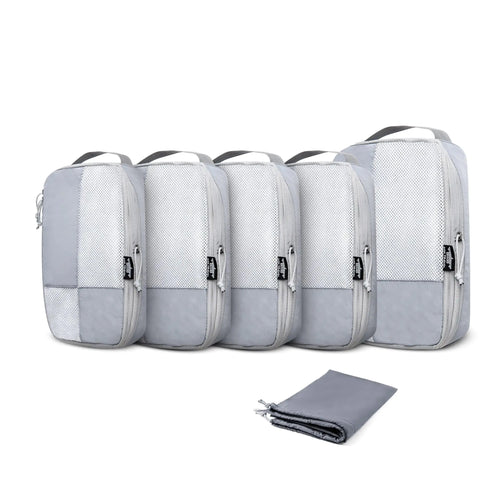
For everything that is not a liquid, the goal is one pouch rather than items loose in the bag. A ventilated toothbrush case keeps a wet brush away from clean clothes, and a compact wash bag holds the rest of a daily routine off a hotel counter that was never big enough. Browse Security & Organization for the full range.
Common questions
Does a stick deodorant count as a liquid?
Solid sticks generally do not. Gel and roll-on versions do. If in doubt, put it in the bag.
Is toothpaste a liquid?
Yes. A standard full-size tube will be removed. Decant it or buy a 100ml tube.
Can I buy liquids after security and carry them onto a connecting flight?
Usually yes if they stay in the sealed tamper-evident bag with the receipt visible, but rules differ by country and some connections re-screen. If the connection involves leaving the secure area, assume you will lose them.
What happens if I forget and pack a full shampoo bottle?
It gets binned. There is no storage and no posting it on. This is the one rule where being slightly over costs you the whole item.
Do these limits apply to checked luggage?
No. Full-size liquids go in the hold — in a sealed bag, because pressure changes affect the hold too.
Written by the advisors at WB Travel Associates, a travel agency in Virginia Beach, Virginia. Security rules vary by airport and country and change without much notice — confirm with your departure airport before you travel. Browse Security & Organization.