The short version: the thing that wakes you on a plane is your head falling forward. Fix head support first. Then block light, then block noise, then keep your legs moving. Solve them in that order and you will sleep on flights where you previously did not.
We book a lot of long-haul travel, and "how do I actually sleep on the plane" is the question we get more than any other. Here is the order of operations we give clients.
1. Head support — the one that matters most
You do not wake up because the seat is uncomfortable. You wake up because your neck muscles have to keep working to hold your head up, and the moment they relax, your head drops and the jolt wakes you. Any pillow that stops the drop will out-perform any amount of seat padding.
What to look for:
- Firmness over softness. A soft pillow compresses under the weight of your head and stops supporting it within an hour. If you have ever wondered why your pillow "stopped working" halfway through a flight, this is why.
- Support at the sides, not just the back. Heads fall sideways more often than backwards.
- Packability, honestly assessed. A pillow you leave at home because it is bulky provides no support at all.
Memory foam gives the most consistent support — the Memory-Foam Travel Neck Pillow is the classic U-shape done properly, and the Ergonomic Memory-Foam Neck Pillow uses a denser core for people who find most pillows too soft. If packing space is the binding constraint, an inflatable like the Inflatable Travel Neck Pillow gives you full-size support that folds into a pocket. We compare the whole line in Which travel pillow is right for you.
2. Light
Cabin light is the second interrupter, and it is the cheapest to solve. Two things separate a good mask from a bad one:
- A seal at the nose. Most light leaks in at the bridge of the nose, not around the edges.
- Space for your eyes. Flat masks press on your eyelids and lashes, which is uncomfortable enough to keep you awake. Contoured masks with raised eye cups let you blink — the Contoured Blackout Sleep Mask is built around this.
If you want to fall asleep to sound without wearing earbuds under a mask, an audio mask such as the Bluetooth Music Sleep Mask puts flat speakers inside the fabric.
3. Noise
Cabin noise on a long-haul flight sits in a range that is more fatiguing than it is loud. You have two options: block it, or mask it. Foam earplugs block broadband noise cheaply and work well. Noise-reducing earbuds like the Hi-Fi Bluetooth Earbuds soften engine drone specifically, which is the frequency that makes you tired.
One practical note: if you plan to sleep, choose whichever you can wear lying against a pillow without pain. Comfort beats performance here.
4. Circulation
Sitting still for hours at altitude causes fluid to pool in the lower legs. That is why shoes stop fitting on descent. Graduated compression socks help by applying more pressure at the ankle than at the calf, encouraging blood back up.
Our line runs from everyday support to firm medical-grade compression — see our guide to compression levels for which one you want. If you have a circulatory condition, a history of DVT, are pregnant, or are recovering from surgery, talk to your doctor before flying rather than choosing from a product page.
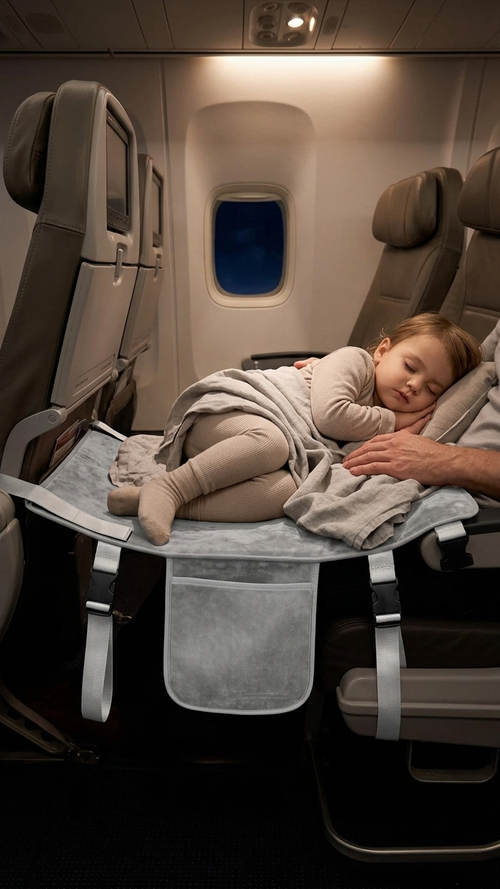
A footrest hammock such as the Portable Leg-Rest Travel Hammock takes pressure off the back of the thighs, which is a surprisingly large part of long-haul discomfort in economy.
What we would skip
- Alcohol as a sleep aid. It shortens time to sleep and worsens sleep quality, and dehydration at altitude compounds it.
- Full-size blankets. A packable travel blanket with a foot pocket like the 2-in-1 Fleece Travel Blanket does the same job in a fraction of the space.
- Anything you have not tried on the ground. A 12-hour flight is the wrong place to find out a pillow does not suit your neck.
Common questions
Window or aisle for sleeping?
Window. You control the shade, you get a wall to lean on, and nobody climbs over you.
Should I try to sleep on the destination's schedule?
Where you can, yes. On eastbound overnight flights, sleeping early usually beats staying up for the meal service.
Do neck pillows work for side sleepers?
The standard U-shape is poor for side sleepers. Look for a contoured pillow with a taller side wall, or a wrap-around design.
Is it worth buying a pillow, mask and blanket together?
Buy the pillow you actually want first — it does most of the work — then add the mask and blanket around it. Bundles tend to pair a good pillow with a mask you will not use, or the reverse.
Written by the advisors at WB Travel Associates, a travel agency in Virginia Beach, Virginia. This article is general travel advice, not medical advice. Browse Travel Comfort.